Emotion Wheel: Decode Your Emotions
Emotions are layered. What we feel on the surface often masks something deeper. Slow down, name your core feelings, uncover the needs underneath, and find practical ways to work through them.
- Self-guided
- Private, nothing saved
- No sign-up
What are you feeling right now?
Select the core emotion that feels closest to your current state.
Understanding Your Emotions
The Iceberg Effect
Think of your emotions like an iceberg. What you feel on the surface, like anger, frustration, or numbness, is often just the visible tip. Beneath the surface lie primary emotions, which are more vulnerable feelings like fear, sadness, or shame. Identifying the core emotion is the first step to processing it.
Why Naming Helps
Psychologists use a phrase: "Name it to tame it." In a UCLA brain-imaging study, putting feelings into words calmed the amygdala, the brain's alarm centre, and switched on a part of the prefrontal cortex that helps regulate emotion. Feeling wheels like this one grew out of therapist Gloria Willcox's 1982 Feeling Wheel, made for exactly this: finding the right word.
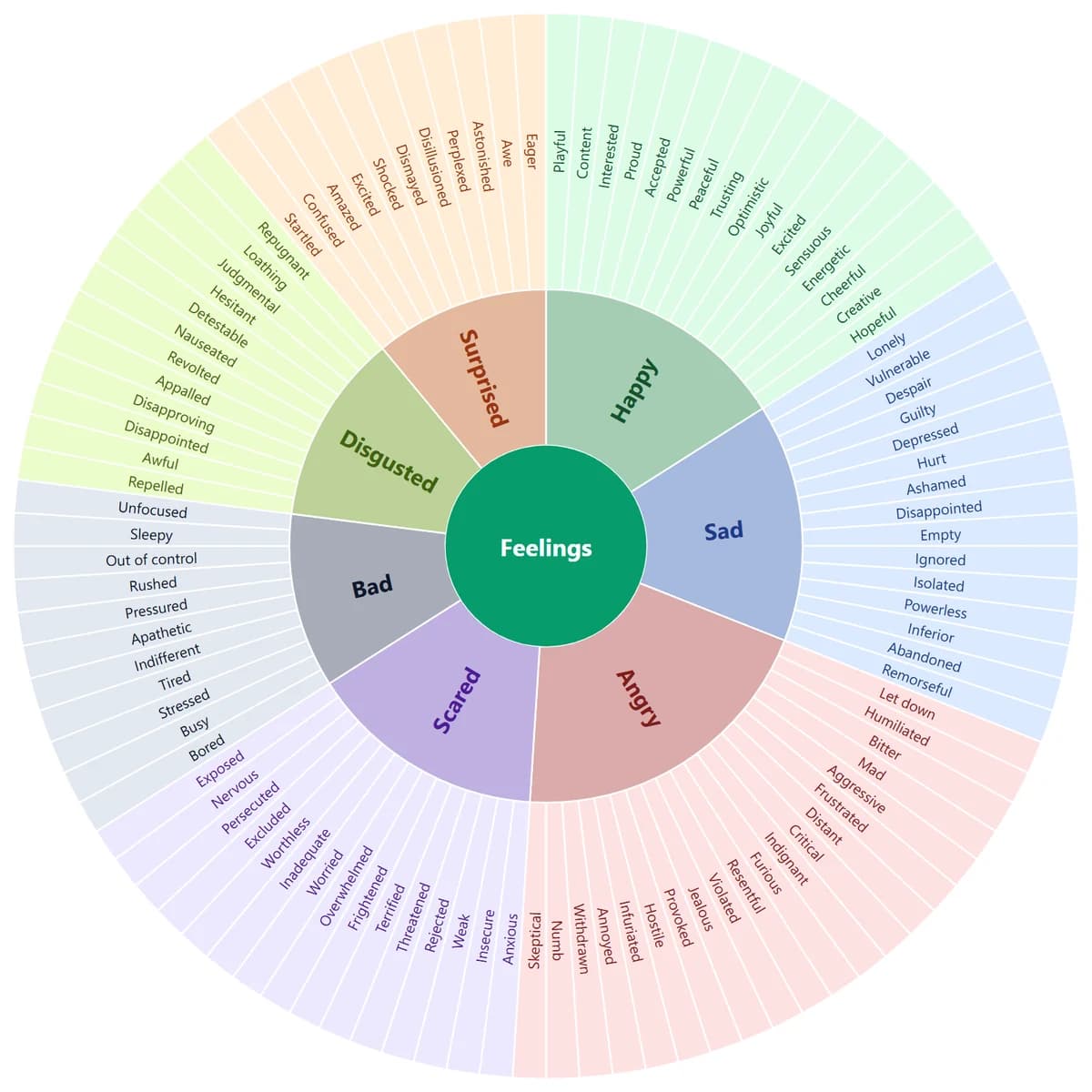
Free Printable Emotion Wheel (PDF)
Prefer paper? Download the emotion wheel as a one-page A4 PDF: 7 core emotions in the centre and 100 more specific feelings around them. Use it for journaling, with a partner, in class, or in workshops and therapy sessions.
Emotion Wheel in Hindi (Hinglish)
The Hinglish version names every feeling the way we actually say it, like Udaas, Gussa, Bojh tale or Khaalipan, with the English word beside it. Useful for families, schools, and anyone who thinks in Hindi.
Frequently Asked Questions
Is there a printable emotion wheel PDF?
How do I know what I am feeling right now?
What is an emotion wheel and how do I use it?
Why is it so hard to identify my emotions?
Why do I feel multiple conflicting emotions at once?
How can therapy help me process my feelings?
Sources
- Putting feelings into words: affect labeling disrupts amygdala activity in response to affective stimuli. Lieberman et al., Psychological Science, 2007.
- The Feeling Wheel: a tool for expanding awareness of emotions and increasing spontaneity and intimacy. Willcox, Transactional Analysis Journal, 1982.
Note: This tool is intended for self reflection and psychoeducation only. It does not replace professional mental health support. If you're struggling, consider booking a session with Aditya.
Want to go deeper than a name?
Naming the feeling is a start. In a session we work out where it comes from and what helps. Online across India or in person in Bangalore.